Two Draft Books

September 13, 2007

If you’re interested in learning about statistical mechanics, graphical models, information theory, error-correcting codes, belief propagation, constraint satisfaction problems, or the connections between all those subjects, you should know about a couple of books that should be out soon, but for which you can already download extensive draft versions.

The first is Information, Physics, and Computation by Marc Mézard and Andrea Montanari.

The second is Modern Coding Theory by Tom Richardson and Ruediger Urbanke.

I also recommend the tutorial on Modern Coding Theory: the Statistical Mechanics and Computer Science Points of View, by Montanari and Urbanke, from the lectures they gave at the 2006 Les Houches summer school.

Cards & Chess

September 10, 2007

If you enjoy Chess, but want to spice it up a bit, you’ll probably enjoy some of the games in this post, which introduce the random element of cards into the royal game.

kc2sm.jpg

The first game(s) you might consider are Knightmare Chess and Knightmare Chess 2 (there is also a slightly different French language version called “Tempête sur L’echiquier”) designed by Bruno Faidutti. This game is a kind of mix between Chess and a trading card game like Magic the Gathering. You’ll hold a hand of cards which will let you do some special event each turn (e.g. “For this turn, any one of your pieces may move as if it were a Knight. You cannot capture a piece with this move.”)

Faidutti, a French historian and sociologist, is one of the best-known and respected game designers. His games tend to have a strongly chaotic element. His most popular game, which I highly recommend, is Citadels (“Citadelles” in French), which is best played with large numbers of players (up to seven, and the closer to that number, the better).

Faidutti has an exceptional web-site, particularly notable for his Ideal Game Library, reviewing hundreds of games.


pic21524_t.jpg

Returning to the subject of cards and Chess, the other set of games I want to recommend is Karten Schach, designed by Reiner Knizia, the prolific German mathematician and game designer whom I already discussed in this post. Karten Schach was a labor of love by Knizia (I can’t imagine he thought it would sell very well, and the rulebook is over 100 pages, mostly taken up by discussions of the game mechanics, with plentiful strategy tips).

It is actually collection of 16 games (plus variants) highlighting all sorts of different possibilities in game design; a kind of game design version of Bach’s variations. The names of the games give you a flavor of the possibilities: “Purist Chess,” “Liar’s Chess,” “Ducat Chess,” “Daredevil Chess,” “Gambler’s Chess,” “Psycho Chess,” “Cornucopian Chess,” “Feudal Chess,” “Generational Chess,” “Oracle Chess,” “Prophet’s Chess,” “Eunuch’s Chess,” “Doppelganger Chess,” “Wicked Witch Chess,” “Mysterious Stranger’s Chess,” and “Capitalist Chess.”

Without explaining the rules in detail, I’ll just briefly describe how a couple are played. In Oracle Chess, you must, at the end of each move, put a card face down which commits you to the piece you will move next turn. In Capitalist Chess, on each turn a card is chosen, and you bid chips to have the right to move the piece displayed on the card. Each game is defined by less than a page of brilliant rules, by the master of boardgame design.

I would recommend that you buy Karten Schach, but it has been out of print since 2001, and the publisher has gone out of business. So instead I will point you to the English translation of the rules by Christine Biancheria and a pdf file for the Cards necessary to play the game. (Thanks to Matthew Gray, for pointing me to the English rules translations when they came out.)

And just as I did for Faidutti, I’d also like to recommend one much more mainstream multi-player Knizia game (in case Chess variants are not your cup of tea). The Knizia game I’ll recommend is “Modern Art,”, one of the most highly rated of the German games; a classic in the auction game genre.

The Hubbard Model: a Tutorial

September 9, 2007

Today, I will introduce a new kind of post at Nerd Wisdom, that I hope to do more of in the future: the tutorial. These posts will be a little more technical than ordinary posts, and will probably run a little longer as well. They are designed to give the intelligent and well-educated scientist an entry into a field for which he or she is not already a specialist.

When working with graduate-student interns, I find myself presenting these types of tutorials constantly. Unfortunately, this type of material is very hard to find in the literature, because it covers material that is too well-known to the specialist, while sometimes being beyond what is available in textbooks. Thus, there tends to be an artificial barrier to entry into new fields.

My first tutorial will cover the Hubbard Model. To keep this post to a reasonable length, I will just include the first part of the tutorial here.


I previously discussed high-temperature superconductivity in cuprates, and mentioned that the detailed mechanism is still controversial. However, what is widely agreed is that, as originally proposed by P.W. Anderson, a good model for these materials is the Hubbard Model (see this paper by Anderson for an entertaining and readable argument in favor of this point). And even if one doesn’t agree with that statement, the Hubbard Model is of enormous intrinsic interest, as perhaps the simplest model of interacting electrons on a lattice.

Despite its simplicity, physicists have not been able to solve for the behavior of the two or three-dimensional Hubbard model in the “thermodynamic limit” (for lattices with a very large number of sites and electrons). Coming up with a reliable approach to solving the Hubbard model has become a kind of holy grail of condensed matter theory.

Note that this is very different from the situation for the classical ferromagnetic Ising model, for which Onsager solved the two-dimensional version exactly in 1944 but where we do not have an exact solution in three dimensions. For the three-dimensional Ising model, we may not have an exact solution, but we understand extremely well the qualitative behavior, and can compute quantitative results to practically arbitrary accuracy. For the Hubbard model, we do not even have know what the qualitative behavior is for two or three dimensional lattices.

I will first describe the model in words, and then show you how to solve for the quantum statistical mechanics of the simplest non-trivial version of the model: the Hubbard model on a lattice with just two sites. I strongly believe that whenever you want to learn about a new algorithm or theory, you should start by solving, and understanding in detail, the smallest non-trivial version that you can construct.

The Full Tutorial

New Features at Nerd Wisdom

September 8, 2007

In response to reader requests, I’ve added a couple new features that you can find on the sidebar. First, there’s a Guest Book page where you can leave comments and suggestions about Nerd Wisdom. Secondly, there’s a listing of books and games that I recommend, along with the posts where they are reviewed, and links where you can buy them.

High-Temperature Superconductivity

September 7, 2007

In 1986, a new class of materials, called “cuprate superconductors,” was discovered by Karl Muller and Johannes Bednorz, which displayed superconductivity (the flow of electricity at zero resistance) at much higher temperatures than had ever previously been found. The discovery raised the possibility of materials that could super-conduct at ordinary room temperatures, which would clearly have great technological implications. Muller and Bednorz were awarded the Nobel Prize in Physics in 1987, which stands as the shortest period ever between a discovery and a Nobel prize.

I was a graduate student at Princeton when the news of high-temperature superconductivity broke, and my Ph.D. advisor was Philip W. Anderson, the 1977 Nobel Laureate in physics who at the time was already probably the most famous and respected condensed matter theorist in the world. (One recent study claimed to show that Anderson is the “most creative physicist in the world;” I found the method of the study highly dubious, but the conclusion is not unreasonable.) Anderson nearly immediately proposed a version of his “Resonating-Valence-Bond” theory for the superconductors, and trying to develop a complete theory has been his primary preoccupation ever since.

woodstock01_thumb.jpg

To give you an idea of the excitement in 1987, take a look at this article, looking back at the March 1987 meeting of the American Physical Society in New York City, characterized as the “Woodstock of Physics.”

I was at that meeting, and as one of Anderson’s students, I was definitely at the epicenter of the excitement, but I was actually rather turned off by the whole atmosphere, and I avoided working on the subject too seriously, focusing instead on neural networks and spin glass theory. (As I mentioned in this post, Anderson also made seminal contributions to those fields, and he let me work on whatever I was interested in.) Nevertheless, it was impossible to avoid being influenced, and I did eventually work on a few papers related to the theory of high-temperature superconductivity.

Sadly, the hopes for room temperature cuprate super-conductivity faded with time, and no cuprates have been discovered which super-conduct above 138 degrees Kelvin. And although our understanding of the materials has improved with time, there is still also considerable controversy about the mechanism causing the superconductivity.

See this post for more information about the Hubbard Model, which underlies the physics of the cuprates.

Using Illusions to Understand Vision

September 6, 2007


checkershrunk001.jpg

MIT professor Edward Adelson uses remarkable visual illusions to help explain the workings of the human visual system. One such illusion is shown above. Believe it or not, the square marked A is the same shade of gray on your computer screen as the square marked B.

checkerproofshrunk002.jpg

Here’s a “proof,” provided by Adelson. Two strips of constant grayness are aligned on top of the picture. You can see that the A square is the same shade as the strips near it and the B square is the same shade as the strips near it. Perhaps you still don’t believe that the strips are of constant grayness. In that case, put some paper up next to your computer screen to block off everything except for the strips; you’ll see it’s true.

Adelson explains the illusion here. The point is that our visual system is not meant to be used as a light meter; instead it is trying to solve the much more important problem (for our survival) of determining the true shade (that is, the color of the attached “paint”) of the objects it is looking at.

You can find more interesting illusions and demos from Adelson and other members of the perceptual science group at MIT, but don’t fail to also take a look at the illusions collected by the lab of Dale Purves at Duke. I particularly recommend the cube color contrast demo, where you can see that gray can be made to look yellow or blue.

Purves, together with R. Beau Lotto, wrote the book “Why We See What We Do: An Empirical Theory of Vision,” which collects these remarkable illusions and also expounds on a theory explaining them. The theory, to summarize it very briefly, says that what humans actually see is a “reflexive manifestation of the past rather than a logical analysis of the present.” I found myself quite uncomfortable with the theory for much the same reasons as given in Alan Gilchrist‘s review.

I also would prefer a more mathematical theory than Purves and Lotto give. It seems to me that we should in general try to explain illusions in terms of a Bayesian analysis of the most probable scene given the evidence provided by the light. My collaborators Bill Freeman and Yair Weiss (both former students of Adelson’s) have long worked along these lines; see for example Yair’s excellent Ph.D. thesis from 1998, explaining motion illusions.

In fact, I would like to go beyond a mathematical explanation of illusions to an algorithmic one. I would argue that a good computer vision system should “suffer” from the same illusions as a human, even though it has neither the same evolutionary history nor the same life history. To take an example of what I have in mind, the famous Necker cube illusion presumably arises naturally from the fact that the two interpretations are both local optima, with respect to probability, so a good artificial system should use an algorithm that settles into one interpretation, but then still be able to spontaneously switch to the other.

Viral Video Geniuses

September 5, 2007

This is one of the funniest videos I’ve seen in the last year, by video director Nalts.

Another of my favorite video directors is Christine Gambito, known as “HappySlip.” She often does very funny one-woman skits based on imitating her relatives (including her father who is always shown from the nose down, eating junk food and saying “disaster”), but I’ll show a different type of video here, because it sets up the third one in this post:

So now you know enough to properly appreciate this one, where Nalts “sneaks into HappySlip’s Pad:”

Consistent Quantum Theory

September 4, 2007

Quantum mechanics is a notoriously confusing and difficult subject, which is terribly unfortunate given its status as a fundamental theory of how the world works. When I was an undergraduate and graduate student of physics in the 1980’s, I was always unsatisfied with the way the subject was presented. We basically learned how to calculate solutions to certain problems, and there was an understanding that you were better off just avoiding the philosophical issues or the paradoxes surrounding the subject. After all, everybody knew that all the challenges raised by physicists as eminent as Einstein had ultimately been resolved experimentally in favor of the “Copenhagen interpretation.”

Still, there was a lot of weird stuff in the Copenhagen interpretation like the “collapse of the wave-function” caused by a measurement, or apparently non-local effects. What I wished existed was a clearly-defined and sensible set of “rules of the game” for using quantum mechanics. The need for such a set of rules has only increased with time with the advent of the field of quantum computing.

cover.gif

In his book, “Consistent Quantum Theory,” (the first 12 out of 27 chapters are available online) noted mathematical physicist Robert Griffiths provides the textbook I wished I had as a student. With contributions from Murray Gell-Mann, Roland Omnes, and James Hartle, Griffiths originated the “consistent history” approach to quantum mechanics which is explained in this book, .

The best summary of the approach can be obtained from the comparison Griffiths makes between quantum mechanics and the previous classical mechanics. Quantum mechanics differs from classical mechanics in the following ways:

1. Physical objects never posses a completely precise position or momentum.
2. The fundamental dynamical laws of physics are stochastic and not deterministic, so from the present state of the world one cannot infer a unique future (or past) course of events.
3. The principle of unicity does not hold: there is not a unique exhaustive description of a physical system or a physical process. Instead reality is such that it can be described in various alternative, incompatible ways, using descriptions which cannot be combined or compared.

It is the 3rd point which is the heart of the approach. In quantum mechanics, you are permitted to describe systems using one “consistent framework” or another, but you may not mix incompatible frameworks (basically frameworks using operators that don’t commute) together.

Griffiths uses toy models to illustrate the approach throughout the book, and provides resolutions for a large number of quantum paradoxes. He stresses that measurement plays no fundamental role in quantum mechanics, that wave function collapse is not a physical process, that quantum mechanics is a strictly local theory, and that reality exists independent of any observers. All of these points might seem philosphically natural and unremarkable, except for the fact that they contradict the standard Copenhagen interpretation.

This is a book that will take some commitment from the reader to understand, but it is the best explanation of quantum mechanics that I know of.

Duke and Pawn Endgames

September 3, 2007

Note: to understand this post, you don’t need to know anything about chess; I’ll explain everything necessary right here.

One of the best ways for a chess beginner to improve is to study king and pawn endgames, and one of the best ways to do that is to play a game with only kings and pawns. Just remove all the rest of the pieces, and have at it.

Unfortunately, while Chess with just kings and pawns is not trivial, as you improve you will eventually outgrow it, because between two good chess players, the game is very likely to end in a draw.

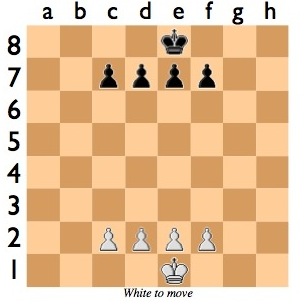
As I mentioned in an earlier post, my son Adam likes to design games, and he designed this very clever variant of the King and Pawn endgame that eliminates the possibility of a draw.
duke001.jpg

Rules:

Set up the pieces as above, with four pawns plus a King for both White and Black.

The players alternate moves, starting with White.

The pawns move as in chess: one square forward, or optionally two squares forward if they haven’t moved yet, and they capture a piece one square ahead of them diagonally.

Pawns may still capture en passant as in Chess, which means the following. If an enemy pawn moves two squares forward, and one of your pawns could have captured it if it had only moved one square forward, you may capture that pawn as if it had only moved one square forward, but only if you do so with your pawn on the turn immediately after the enemy pawn moves.

The Kings can only move one square up or down, or left or right; they cannot move diagonally. (Such limited versions of Kings are sometimes called “Dukes;” hence the title of this post.)

You win the game immediately if you capture the opponent’s King, or if one of your pawns reaches the other side of the board.

You must always move; if you cannot make a legal move, you lose the game. (This is different from Chess, where stalemate is a draw.)

You may not make a move which recreates a position that has previously occurred during the game. (This is also different from Chess, but such a rule exists in Shogi, the Japanese version of Chess.)

That’s all the rules. In this game, draws are impossible, even if only two Kings remain on the board. For example, imagine that the White King is on a1, and the Black King is on b2. If White is to move, he loses, because he must move to a2 or b1, when Black can capture his King. But if Black is to move, he must retreat to the north-east, when White will follow him, until Black eventually reaches h8 and has no more retreat.

So arranging that your opponent is to move if the two Kings are placed on squares of the same color (if there are no pawn moves) is the key to victory. This concept, known as the “opposition,” is also very important in ordinary Chess King and pawn endgames, which is why skill at chess will translate into skill in this variant, and why improving your play at this variant will improve your Chess. Of course, the pawns are there, and they complicate things enormously!

Naturally, one can consider other starting positions, with different numbers of pawns.

This game can be analyzed using the methods of Combinatorial Game Theory (CGT). Noam Elkies, the Harvard mathematician, has written a superb article on the application of CGT to ordinary chess endgames, but it required great cleverness for him to find positions for which CGT could be applied; with this variant, the application of CGT should be much easier.