Music in Computer Games and Windows on Macs

September 2, 2007

kennedycenter.jpg

For certain genres of computer games, such as grand strategy games, the music can make a huge difference in the experience. One of the reasons that Civilization IV has been such a great hit is its wonderful music, particularly composer Christopher Tin‘s beautiful menu track “Baba Yetu” and opening track “Coronation.”

This music has attracted considerable notice; the picture above, taken from Tin’s website, is of the National Symphony Orchestra and the Washington Master Chorale performing “Baba Yetu” at the Kennedy Center. Tin makes “Baba Yetu” and “Coronation” (actually remixed versions slightly different from the computer game versions) available for download at his samples page, along with other samples of his work. (To download, just right-click and “save link” instead of left-clicking.) If you’re curious, the lyrics for “Baba Yetu” are actually a version of the Lord’s Prayer in Swahili.

My son Adam really enjoys playing the historical grand strategy games produced by Paradox Entertainment (Europa Universalis II, Victoria, Crusader Kings, and right now especially Europa Universalis III.) These games also have excellent music, but there are some tracks that he prefers more than others, and the music sometimes gets too repetitive in Europa Universalis III because there’s not as many tracks as he’d like. Adam also told me would play Crusader Kings mostly for its excellent music, and he would read the “Civilopedia” in Civ IV because it would let him listen to “Baba Yetu.”

Well, to give him a little more control, we made a playlist in iTunes, and put in only the tracks he likes from the games we own, and now he’s completely set. He just turns off the game music and uses his iTunes playlist instead. Speaking of iTunes on Windows, this is a funny quote from Apple’s CEO Steve Jobs a couple months back:

And speaking of running Windows on an Intel iMac using Bootcamp, which is what we do to run Windows-only games, this is a very funny link, but it’s not really accurate. Honestly our iMac running Windows (we actually run Windows XP instead of Vista because it runs games better, and is more stable) is easily the fastest and most stable Windows machine I’ve ever seen, probably largely because it’s missing all the bloat that normally comes on a PC (and because I’m very careful about what gets installed on it.) Walt Mossberg from the Wall Street Journal also reports that an iMac running Vista is the best Vista machine he’s seen.

The Life of the Lab Biologist

September 1, 2007

As I mentioned in a previous post, I was lucky to be able to attend, as a student, the 2006 Molecular Biology of Aging summer course at the Woods Hole Marine Biology Laboratory. This three week course was intensive; part the time was spent in lectures, where many of the world’s leading experts on aging explained their research in detail (and the students were able to ask lots of questions), and the rest was spent in the lab. There was also often time to attend some of the many other stimulating talks in molecular biology or neuroscience being held elsewhere at Woods Hole. Because the subject was so far from my normal research, I took vacation time to attend; I suppose it doesn’t seem like much of a vacation, but in fact Woods Hole is incredibly stimulating, and it was one of the most memorable and refreshing vacations I’ve ever had.

We performed real experiments in the lab, as the other students were all biology post-docs and grad students who were there to learn cutting edge techniques. I was also assigned to a group, led by Dr. Meng Wang, a post-doc in Gary Ruvkun’s lab, and we learned how to perform RNA interference (RNAi) screens on the nematode worm C. Elegans.

The RNAi technique lets you suppress the transcription of any single gene in the worm’s genome. An “RNAi screen” means that you divide the population of worms that into groups organized so that each group has a different gene suppressed, and you make sure that you have a group for each gene in the genome. For each group of worms, you check whether it has some phenotype that you’re interested in (in our case it was the ability to breed at a later age than usual). That way, you can quickly find genes that are involved in the phenotype.

216878320_502fcdb4c2.jpg

The picture above is from the lab at Woods Hole. From left to right are Michael Morissette, Andrew Midzak, Serkalem Tadesse, myself, and John Cumbers. The others have finished their work, but I was slower than everybody else, so I’m guessing that I was still counting worms or something.

Biologists work incredibly long hours at the lab, often doing work that is exciting in terms of its implications, but sometimes pretty dull and repetitive in the doing; biologists are dedicated people! On the other hand, lab life seems much more social compared to the life of a computer scientist or physicist. (Although there is much more social interaction in those fields than in fields like history, as I know by observing my historian wife. I always find it ironic that humanists, who tend to be outgoing people, usually find themselves working in a much more solitary way than scientists.)

One thing I learned was that lab biology is largely a matter of learning and using “protocols,” which are basically like scientific recipes. Take a look at this amusing video, which features the highly talented John Cumbers (who was one of my lab-mates) and produced by the Brown iGEM team:

Another protocol was for “picking” worms (moving them from one petri dish to another). An adult C. Elegans is only about 1 millimeter long, so picking them up is not easy. You do it under a microscope with a special thin wire (a “picker”). You sort of try to scoop them up, but the worms run away! It’s like a video game, except not nearly as fun, really. Here’s a video showing the technique in action.

You should notice by the way that the picked worm is glowing. That’s because the worm is a mutant: a gene for a fluorescent protein has been spliced into its genome attached to another gene (daf-12) of interest. That way you can know where daf-12 is expressed in its body. (This video was submitted by user a99xel to YouTube).

Richard Feynman

August 31, 2007

Richard Feynman has been one of my heroes, ever since the end of my freshman year at Harvard. After my last final exam, but before I headed home for the summer, I was able to sit in the beautiful Lowell House library, without any obligations, and just read chapters from his wonderful Lectures on Physics. After that there wasn’t much doubt in my mind about what I wanted to do with my life.

There’s a lot to say about Feynman, but I will restrict myself for now to a couple rather recent items which give a picture of the character of this remarkable man. First, there is this 1981 BBC Interview, recently released to the web, where you can see him briefly discuss a few of the things that were important to him.

images3.jpg

Secondly, if you haven’t read Perfectly Reasonable Deviations From the Beaten Track, the collection of his letters edited by his daughter Michelle Feynman that was published in 2005, you owe it to yourself to do so. I was skeptical at first that a book of letters, even those of Feynman, could be very interesting, but I wound up reading every word.

Let me just give you one example of a pair of letters from 1964:

Dear Professor Feynman,

Dr Marvin Chester is presently under consideration for promotion to the Associate Professorship in our department. I would be very grateful for a letter from you evaluating his stature as a physicist. May I thank you in advance for your cooperation in this matter.

Sincerely,
D.S Saxon
Chairman
Dick: Sorry to bother you, but we really need this sort of thing.
David S.

Dr. D.S. Saxon, Chairman
Department of Physics
University of California, Los Angeles
Los Angeles, California

Dear David:

This is in answer to your request for a letter evaluating Dr. Marvin Chester’s research contributions and his stature as a physicist.

What’s the matter with you fellows, he has been right there the past few years–can’t you “evaluate” him best yourself? I can’t do much better than the first time you asked me, a few years ago when he was working here, because I haven’t followed his research in detail. At that time, I was very much impressed with his originality, his ablity to carry a theoretical argument to its practical, experimental conclusions, and to design and perform the key experiments. Rarely have I met that combination in such good balance in a student. Was I wrong? How has he been making out?

Sincerely yours,
R.P. Feynman

The above letter stands out in the files of recommendations. After this time, any request for a recommendation by the facility where the scientist was working was refused.

Edit: In the comments below, Shimon Schocken recommends Feynman’s “QED.” I thought of this book after finishing this post. It’s an amazing work. In it, Feynman gives a popular account (you don’t need any physics background to follow it) of his theory of quantum electrodynamics, for which he won the Nobel Prize. But it’s a popular account that makes no compromises in its scientific accuracy. The other books recommended in the comments (“Six Easy Pieces” and “Surely You’re Joking”) are also definitely great books, but “QED” is somehow often overlooked, even though it is the book that Feynman himself recommended to those interested in his work.

Prediction Markets

August 30, 2007

What does it mean to say that “I believe that Hillary Clinton has a 42% chance to win the 2008 U.S. Presidential election?” It used to be that some academics (called “frequentists”) had problems with this statement, because they only wanted to talk about probabilities for experiments that, at least in principle, could be run many times, to permit a reasonable estimate of the frequency of some event. I think hardly anybody is a frequentist anymore.

One good operational definition of the above statement is that if you offer me a choice between $1.00 if Hillary Clinton wins, or $0.42 regardless of whether or not she wins, I am indifferent. If you offer me less than the $0.42, I’ll take the chance on Senator Clinton, if you offer me more, I’ll go with the sure thing.

Nowadays, we can get good estimates of the probabilities of many interesting events from prediction markets like TradeSports for sporting events, or Intrade for political and other events. In these markets, participants buy and sell contracts of the above variety, so that the market provides a consensus probability for a particular event.

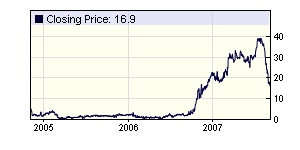
closingchart.jpg

I find these markets fascinating. You can find out for example, looking at the chart above, that Senator Obama’s apparent chance of winning the Democratic nomination has fallen from around 39% to around 17% over the last few weeks (presumably because of the fallout over his statements on foreign policy). Or that the New England Patriots off-season acquisitions have increased their chances of winning the next Super Bowl from about 7% to 17%.

There’s some bias towards American sports and politics, but events like the recent French Presidential election are also heavily traded.

I’ve just been an observer, and I intend to stay that way, but if you’re interested, but don’t want to use real money, Intrade recently began letting you play with pretend dollars.

Combinatorial Game Theory

August 29, 2007

Combinatorial Game Theory (CGT) is a mathematical discipline that studies two-player, zero-sum games, where the players play sequentially, and there is perfect information and no chance. The aim of CGT is to build mathematical theories that will help players win such games! In practice, the ideas from CGT are of minimal help to the serious player in more complicated games like Chess or Go, but the theories are extremely helpful for simpler but still non-trivial games like Dots-and-Boxes.

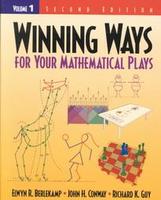
9781568811307.jpg

The CGT bible is Winning Ways for Your Mathematical Plays, a four-volume set of books (for the 2nd edition from the early 2000’s; the first edition from 1982 was in two volumes), by the eminent mathematicians Elwyn Berlekamp, John Horton Conway, and Richard Guy.

The basic idea of CGT is to develop a calculus, which lets you assign a value to a position in the game. One normally considers games with the condition that a player who cannot move loses. If both players are without a move in a position (whoever moves loses), the position is assigned a value of 0. If the player on the right can make one move that transforms the position to one of value 0, and the player on the left cannot move at all, the position is assigned a value of 1 (if the roles are reversed, the position has value -1).

Now what happens if the player on the left has a move to a position of value 0, and the player on the right has a move to a position of value 1? What is the value of that position? It turns out to be worth 1/2, as can be seen by considering the position obtained by adding such two such positions together with a position of value -1, when one gets back to a position of value 0 where whoever moves loses (I’ll let you work out the details).

There are more different kinds of values than just fractions. Berlekamp, Conway, and Guy consider a multitude of different interesting games, which give rise to ever deeper mathematics, and game positions with strange values along with complex rules for combining those values.

The writing is informal, with constant punning, but the mathematics is serious. Still, one charm of the field is that there is no pre-requisite mathematical material needed to understand these books–bright high school students can launch right in.

After finishing “Winning Ways,” the ambitious student can move on to the two volumes “Games of No Chance” and “More Games of No Chance” (note that nearly all the papers in these books are available online), and then move onto the rest of the papers collected at David Eppstein‘s CGT page.

Also, take a look at Aaron Siegel‘s Combinatorial Game Suite software to help you do CGT computations.

There’s still much more to say, but I’ll leave that for other posts.

On Rationality

August 28, 2007

I want to expand on what I wrote previously in “A Simple But Challenging Game: Part II, this time focusing on Rosenthal’s Centipede Game. To remind you of the rules, in that game there are two players. The players, named Mutt and Jeff, start out with $2 each, and they alternate rounds. On the first round, Mutt can defect by stealing $2 from Jeff, and the game is over. Otherwise, Mutt cooperates by not stealing, and Nature gives Mutt $1. Then Jeff can defect and steal $2 from Mutt, and the game is over, or he can cooperate and Nature gives Jeff $1. This continues until one or the other defects, or each player has $100.

As I previously wrote, in this game, the Nash equilibrium is that Mutt should immediately defect on his first turn. This result is obtained by induction. When both players have $99, it is clearly in Mutt’s interest to steal from Jeff, so that the he will end with $101, and Jeff will end with $97. But that means that when Jeff has $98 and Mutt has $99, Jeff knows what Mutt will do if he cooperates, and can see that he should steal from Mutt, so that he will end with $100 and Mutt will end with $97. But of course that means that when both players have $98, Mutt can see that he should steal from Jeff, and so on, until one reaches the conclusion that Mutt should start the game by stealing from Jeff.

Of course, this Nash equilibrium behavior doesn’t really seem very wise (not to mention ethical), and experiments show that humans will not follow it. Instead they usually will cooperate until the end or near the end of the game, and thus obtain much more money than would “Nashists” who rigorously follow the conclusions of theoretical game theory.

Game theorists often like to characterize the behavior of Nashists as “rational,” which means that they need to explain the “irrational” behavior of humans in the Rosenthal Centipede Game. See for example, this economics web-page, which gives the following “possible explanations of ‘irrational’ behavior”:

There are two types of explanation to account for the divergence. The first assumes that the subject pool contains a certain proportion of altruists who place a positive weight in their utililty function on the payoff of their opponent. Also to the extent that selfish players believe that there is some probability that other players are altruists, they have an incentive to mimic altruistic behaviour by passing.

The second explanation considers the possibility of action errors. Errors in action, or ‘noisy’ play, may result from subjects experimenting with different strategies. Or simply from subjects pressing the wrong key.

Let’s step back for a second and consider what “rational” behavior should mean. A standard definition from economics is that a rational agent will act so as to maximize his expected utility. Let’s accept this definition of “rational.”

The first thing we should note is that “utility” is not usually the same as “pay-off” in a game. As noted in the first explanation above, many people get utility from helping other people get a pay-off. But there are many other differences between pay-offs and utility. You might lose utility from performing actions that seem unethical or unjust, and gain utility from performing actions that seem virtuous or just. You might want to minimize the risk in your pay-off as well as maximize the expected pay-off. You might value pay-offs in a non-linear way, so that the difference between $101 and $100 is very small in terms of utility.

Of course, this difference between pay-off and utility is very annoying theoretically. We’d really like the pay-offs to strictly represent utilities, but unfortunately for experiments, it is only possible to hand out dollars, not some abstract “utils.”

But suppose that the pay-offs in the Rosenthal Centipede Game really did represent utils. Would the game theory result really be “rational” even in that case? Would the only remaining explanation of cooperating behavior be that the players just don’t understand the situation and are making an error?

No. Remember that to be “rational,” an agent should maximize his expected utility. But he can only do that conditioned on some belief about the nature of the person he is playing with. That belief should take the form of a probability distribution for the possible strategies of his opponent. A Nashist rigidly reasons by backward induction that his opponent must always defect at the first opportunity. He even believes this if he plays second, and his opponent cooperates on the first turn! But is this the most accurate belief possible, or the one that will serve to maximize utility? Probably not.

A much more accurate belief could be based on the understanding that even people who understand the backward induction argument can reason beyond it and see that many of their opponents are nevertheless likely to cooperate for a long time, and therefore it pays to cooperate. If you believe that your opponent is likely to cooperate, it is completely “rational” to cooperate. And if this belief that other players are likely to cooperate is backed by solid evidence such as the fact that they started the game by cooperating, then the behavior of the Nashist, based on inaccurate beliefs that cannot be updated, is in fact quite “irrational,” because it does not maximize his utility.

Sophisticated game theorists do in fact understand these points very well, but they muddy the waters by unnecessarily overloading the term “rational” with a second meaning beyond the definition above; they in essence say that “rational” beliefs are those of the Nashist. For example, take a look at this 1995 paper about the centipede game by Nobel Laureate Robert Aumann. Aumann proves that “Common Knowledge of Rationality” (by which he which he essentially means the certain knowledge that all players must always behave as Nashists) will imply backward induction. He specifically adds the following disclaimer at the end of his paper:

We have shown that common knowledge of rationality (CKR) implies backward induction. Does that mean that in perfect information games, only the inductive choices are appropriate or wise? Would we always recommend the inductive choice?

Certainly not. CKR is an ideal (this is not a value judgement; “ideal” is meant as in “ideal gas”) condition that is rarely met in practice; when it is not met, the inductive choice may be not only unreasonable and unwise, but quite simply irrational. In Rosenthal’s (1982) centipede games, for example, even minute departures from CKR may make it incumbent on rational players to “stay in” until quite late in the game (Aumann, 1992); the resulting outcome is very far from that of backward induction. What we have shown is that if there is CKR, then one gets the backward induction outcome; we do not claim that CKR obtains or “should” obtain, and we make no recommendations.

This is all well and good, but why use the horribly misleading name “Common Knowledge of Rationality” for something that would be more properly called “Universal Insistence on Idiocy?”

I hope it is obvious by now why I am skeptical of explanations of various types of human behavior that are based on assuming that all humans are always Nashists, and even more skeptical of recommendations about how we should behave that are based on those same assumptions.

[Acknowledgement: I thank my son Adam for discussions about these issues.]

Testing in Python Using doctest

August 26, 2007

Along with using version control, another absolute key to developing reliable software is to systematically test your code as you write it. After all, source code needs to be bug-free to function properly, but all human beings generate bugs at a very high rate when writing code.

Fortunately, Python makes testing remarkably easy and convenient with its doctest module, which lets you put your tests right into your doc strings.

Here’s a tiny example of its use (for more, go to the documentation):


def cube(x):
    """
    >>> cube(10)
    1000
    """
    return x * x

def _test():
    import doctest
    doctest.testmod()

if __name__ == "__main__":
    _test()

I intentionally left a bug in this code. Here’s what happens when I run it:


[yedidia ~] python cube.py
**********************************************************************
File "cube.py", line 3, in __main__.cube
Failed example:
    cube(10)
Expected:
    1000
Got:
    100
**********************************************************************
1 items had failures:
   1 of   1 in __main__.cube
***Test Failed*** 1 failures.

An advantage of using doctest is that your doc strings will serve as examples, as well as tests, of the functions that they document. Examples are often the best kind of documentation for a function.

In fact, I find that if a function doc string explains the inputs to the function, the variable(s) returned by the function, and any side effects, along with the doctest examples, then there is rarely any need for other comments.

My favorite way to develop python code is actually within Emacs. I write a test for a function, then write the function itself, and then type Control-C Control-C in Emacs. Control-C Control-C will execute the python code. If your code is set up to run a _test() function like the code above, then Emacs will open up another buffer which will contain any doctest failures. When all the tests pass, I finish up the documentation of the inputs, outputs, and side effects. That way you can systematically build up your software, one reliable and documented function at a time, while never leaving Emacs.

Emin Martinian taught me this technique. Another approach is to use the IPython enhanced python shell.

Note: to have Control-C Control-C execute python code, you’ll need to add the following lines to your .emacs file (more details here):


(autoload 'python-mode "python-mode" "Python Mode." t)
(add-to-list 'auto-mode-alist '("\.py\'" . python-mode))
(add-to-list 'interpreter-mode-alist '("python" . python-mode))

Of course, you should always keep all your old tests, both because they serve as examples, and also because if any new code somehow breaks an old function, you’ll see it immediately.

Computer Chess Software

August 26, 2007

The best chess playing entity in the world today is almost certainly the computer program “Rybka,” developed primarily by International Master Vasik Rajlich.

Rybka currently tops all the computer chess rating lists. Since Rybka is pretty clearly stronger than the Deep Fritz program that defeated World Champion Vladimir Kramnik 4-2 last year, there’s not much doubt that it is better than any human chess player.

Rybka is available as a plug-in chess engine, which means that you also need to have a chess graphical user interface (GUI) to use it. There are a variety of GUI’s available, including the free Arena GUI.

Rybka plays wonderful chess of course. It is free of all the problems that used to plague computer programs–for example it freely sacrifices material for positional compensation. Nevertheless, it’s not the program that I prefer, for a couple reasons.

First, it is only available for Windows (and Linux using Wine), and I wanted a program for Mac OS X. The strongest program for Macs is clearly Hiarcs 11, developed by Mark Uniacke. Although Hiarcs 11 seems to be somewhat weaker than Rybka, it is still stronger than Deep Fritz, and any human being.

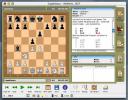
gamewin.jpg

Most importantly, on Macs, Hiarcs is paired with the very nice chess “Sigma Chess” GUI. This GUI/engine combination sports the absolutely crucial feature, missing from any version of Rybka, that you can adjust its strength down to any level from world champion to amateur levels as low as 1250 Elo. If you don’t know what 1250 Elo means, you’re probably an amateur who will lose to a 1250–it’s the level amateurs typically reach after playing in tournaments for about one year. (Note: to obtain this feature on the Mac, you’ll need to spend $20 to get the “Pro” version of Sigma Chess, plus $50 for Hiarcs 11. You should also be able to adjust the level of Hiarcs on Windows GUI’s like Arena, although I have no personal experience with this.)

Amazingly, at whatever level you choose, Hiarcs plays a very human-like game. Previous computer programs, when weakened, played poorly strategically, but still did not make tactical errors. A weakened Hiarcs will make tactical mistakes that you can take advantage of, and will also play at an appropriate level of strategic understanding, so there is no particular reason to adopt anti-computer approaches when playing against it.

Of course, Hiarcs comes with many other features, including the ability to use it to analyze your games. Most grandmasters use these programs to aid in their training, and Hiarcs is well-known as one of the best engines to use.

Personally, I also enjoy just watching my Hiarcs 11.2 engine play blitz chess against the 11.1 engine that I previously used. It’s like watching a couple world champions duke it out. I think it’s worth appreciating, that at least for the game of chess, we now have $50-$70 software running on commodity hardware, that essentially passes the Turing test.

If you are a beginner, you might be better off choosing the mass-market Chessmaster, which comes packed with a lot of nice tutorials, as well as some very weak opponents to start with. However, I don’t like Chessmaster as much as Hiarcs because the weakened opponents in Chessmaster have the strong-tactics weak-strategy characteristics of computer programs that become so tiresome after a while.

The Teaching Company

August 24, 2007

My wife and I are both big fans of the college courses produced by the Teaching Company. The courses cover a wide variety of subjects, and come in a range of video and/or audio formats.

I personally find that the audio format usually works somewhat better. The lecturers are very good, but watching a professor lecture on TV is inevitably somewhat dull. On the other hand, when I’m driving or riding in a car or train, I find that an audio lecture fills an ideal amount of mental bandwidth. (Every so often, the lecture gets complicated at the same time as the driving, but one can always rewind).

My favorite course so far was Robert Greenberg’s course on How to Listen to and Understand Great Music. Music courses are naturally a great fit for an audio course!

Otherwise, there are unfortunately not that many science and mathematics courses that go beyond the beginning undergraduate level, although I did enjoy Stephen Nowicki’s course on Biology. If you are interested in history or philosophy, or other subjects in the humanities (like my wife, who is a historian) there are many more interesting options.

The Teaching Company has an unusual pricing policy. The courses are very expensive, except when they go on sale, when they cost roughly one quarter the normal price and are very reasonable. All the courses go on sale on a regular rotation, so unless you are in a tremendous hurry, you should definitely wait until the course you are interested in goes on sale. A lot of the courses are available at libraries too, so you can borrow one to see if you like it first.

Here’s another blog post endorsing the Teaching Company, with some reader comments on their favorite courses.

Programming Erlang

August 23, 2007

CPU’s stopped getting faster about five years ago. Since then, Intel and AMD started introducing multi-core processors, and the trend for the foreseeable future seems to be more and more processors per computer. That will be great, so long as the software industry is able to take advantage of the increased number of processors to deliver bigger and faster applications. However, that means parallel programming is in our future, and parallel programming is hard.

What’s more, the current dominant paradigm to take advantage of multiprocessor systems is threads, and threads appear to have very serious problems. Berkeley professor Edward Lee argues in no uncertain terms that the inherent non-determinism of threads programming dooms any software testing approach to failure, and will lead to buggy unreliable programs:

“A folk definition of insanity is to do the same thing over and over again and to expect the results to be different. By this definition, we in fact require that programmers of multithreaded systems be insane. Were they sane, they could not understand their programs.”

“These same computer vendors are advocating more multi-threaded programming, so that there is concurrency that can exploit the parallelism they would like to sell us. Intel, for example, has embarked on an active campaign to get leading computer science academic programs to put more emphasis on multi-threaded programming. If they are successful, and the next generation of programmers makes more intensive use of multithreading, then the next generation of computers will become nearly unusable.”

images-1.jpg

Having read Lee’s paper, I was very interested when I learned of Joe Armstrong’s new book “Programming Erlang: Software for a Concurrent World.” Armstrong actually identifies a problem with threads that is related to but slightly different than non-determinism: the fact that different threads can access the same memory. Why is shared memory a big problem? Briefly, because a thread or process that needs to access shared memory must lock it, and if it crashes while the memory is locked, you’re in trouble. For more, see this post.

So what is Erlang, and what is it like? Well, it’s open-source, and has been developed and used in telecom companies for a long time, so there already exist extensive libraries. It is a general-purpose language designed for concurrent, distributed, and fault-tolerant applications. It adheres strongly to the functional programming paradigm. It is a dynamic language, comes with a shell, and uses pattern-matching extensively. In Erlang, it is easy to spawn very large numbers of very-lightweight processes. Processes communicate using messages, and do not share any memory. All in all, it’s a very funky language.

So far, I have only read a small portion of Armstrong’s book (through chapter 8, where concurrent programs are introduced), but it is already clear to me that this is a significant piece of work, well worth the time spent with it. Starting from scratch, Armstrong works his way up to explaining complex distributed and fault-tolerant applications, such as a streaming media server, that require surprisingly little code. I plan to say more in future blog posts, as I progress through the book. In the meantime, here’s a list of beginner Erlang links.

(By the way, in his paper quoted above, Edward Lee discusses Erlang briefly, and says that he believes that its unfamiliar syntax will continue to block its wide-spread adoption. I’m not so sure–perhaps Erlang has simply not broken through until now because there just wasn’t much need for a language suited for multi-processor programming.)